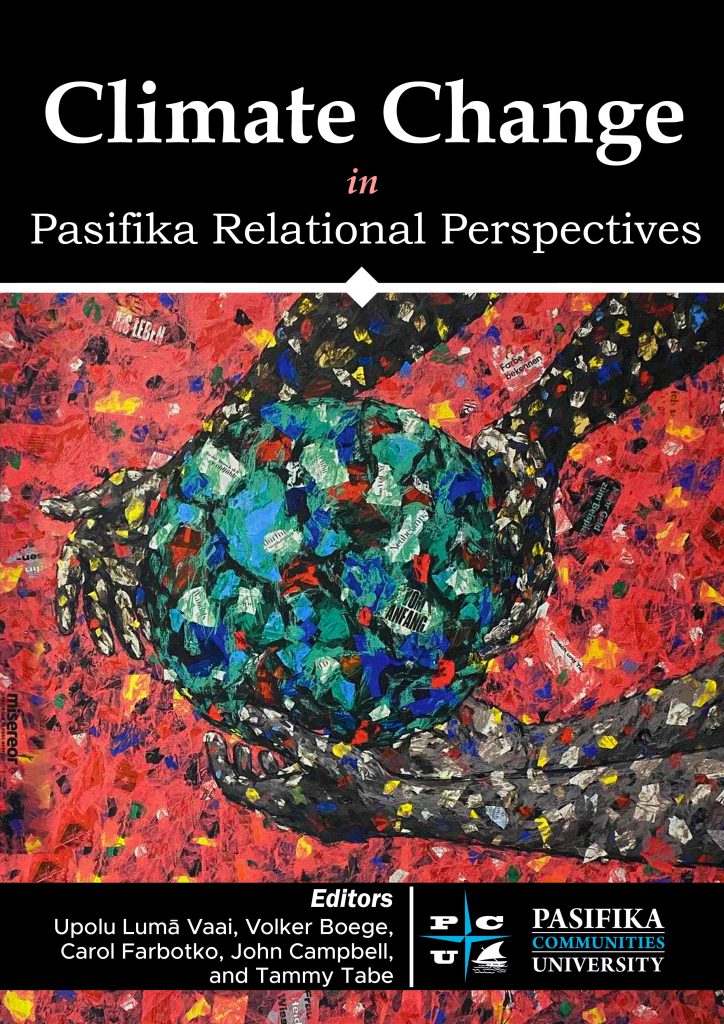
Edited by: Upolu Lumā Vaai, Volker Boege, Carol Farbotko, John Campbell, and Tammy Tabe
Publication Date: April 2026
Publisher: PCU Press, Suva, Fiji Islands

Edited by: Upolu Lumā Vaai, Volker Boege, Carol Farbotko, John Campbell, and Tammy Tabe
Publication Date: April 2026
Publisher: PCU Press, Suva, Fiji Islands
Volker Boege, Upolu Lumā Vaai, John Campbell, Carol Farbotko, Elise Huffer, Iemaima Vaai, Bedi Racule, Paulo Baleinakorodawa, Kate Higgins, Geogianna Lepping, Anna Naupa, Ria Shibata, Sylvia Frain, Tereeao Teingiia, Taukiei Kitara, Tafue Lusama, Meriseta Kitara, Monique Pitasua, Vanessa Organo
“This volume stands as a compelling testament to Pacific thoughts and wisdom, Pacific leadership, and Pacific collective goals. Climate science and communities-based relational knowledge must be held together in a ‘whole of life’ fashion for an effective approach to climate change, security, and peace”―Hon. Sitiveni Rabuka, Prime Minister of Fiji
“This timely and compelling volume reimagines the climate–conflict–peace nexus through the wisdom of Pasifika relationality. It challenges the dominant colonial climate narrative by offering alternatives to mainstream models of thinking that centre Indigenous knowledge, spirituality, and the profound land–people–moana connection. It illuminates dimensions of climate security too often overlooked—cultural, epistemic, and ontological loss, honouring community agency and foster holistic, just, life-affirming futures”―Hon. Maina Vakafua Talia, PhD, Minister of Home Affairs, Climate Change and Environment, Government of Tuvalu
“A groundbreaking contribution that is a must for anyone seeking to understand the unique social and cultural costs of climate change to Pasifika peoples, and emic approaches to sustain their dignity and wellbeing through a changing climate”―Professor Jon Barnett, University of Melbourne
“This vital volume counters neo-colonial narratives on the presumed inevitable inhabitability of atolls due to rising sea levels. Instead, it offers vibrant, thoroughly multi-disciplinary perspectives on a deeply rooted sense of relationality. It breathes not of despair but of a lyric celebration of life. The centre of excellence in scholarship on climate change in the humanities is shifting towards Pasifika. A truly impressive volume!”―Professor Ernst M. Conradie, Senior Professor, University of the Western Cape
“This volume holds with care much needed Pacific narrated understandings of climate change threats to our ways of being, knowing, living and futures. The authors elevate the ever present yet obscured holism and centrality of Pasifika relationality in global and local spaces and places. In their interconnected telling of community and country agency, contributors move beyond the debilitations of dominant discourses and point us towards tangible future research, policy and practice destinations. Te Aroa te Atua.”―Dr Tina Newport, University of Auckland
“Sometimes we get caught up with the Science and Politics of climate change that we forget that like any environmental issue, at the centre are people and relationships – our relationship with each other, with nature or creation and ultimately with God. This book conveys that the way to address the climate crisis and to build climate resilience is to manage and strengthen our relationships with the whole ‘Household of God.’―Sefanaia Nawadra, Director General, Secretariat of Pacific Environment Program, Samoa
This volume posits that relational perspectives from Pasifika communities hold the key to the climate crisis. Recognising that the climate crisis is a global multifaceted issue, the Pasifika communities offer a relational perspective that is liberative and life-affirming. A perspective that recognises the sacred knowledge and wisdom of Pasifika communities and forebears often sidelined by the mainstream climate discourse. While science, technology, and evidence-based policy remain critical, they cannot stand alone. Climate science therefore cannot stand alone. It needs to listen and incorporate the relational and communities-based perspectives of those mostly impacted by the climate crisis. This relational approach provides the ingredients and guide to produce quality research and solutions that are effective rather than reactive, relational rather than transactional, spiritual rather than just technical, and grounded in long-term responsibility and care, guided by Pasifika custodianship wisdom. This volume offers a distinctly philosophical, ethical, and forward-looking perspective to frame a ‘whole of life’ response to the climate crisis that looks beyond one-dimensional and purely technical policy framings. It portrays Pasifika not as a vulnerable region, but rather a region of solutions, leadership, and innovation grounded on the agency of their philosophies, ethics, and spiritualities developed and tested for centuries by their forebears to respond to intergenerational crises such as climate change.